Article
The Modular Ad Creative System for DTC: A Practical Guide to Producing, Iterating, and Scaling Winning Concepts Across Meta, TikTok, and YouTube
Learn how DTC brands can build, test, and scale modular ad creative across Meta, TikTok, and YouTube. Use this practical guide to improve performance.
A direct-to-consumer brand rarely runs out of advertising ideas overnight. It runs out of usable creative. One winning video gets adapted too slowly, a product shoot produces too few variations, and media buyers are forced to spend more budget against assets that audiences have already seen. The result is creative fatigue, inconsistent testing, and rising acquisition costs.
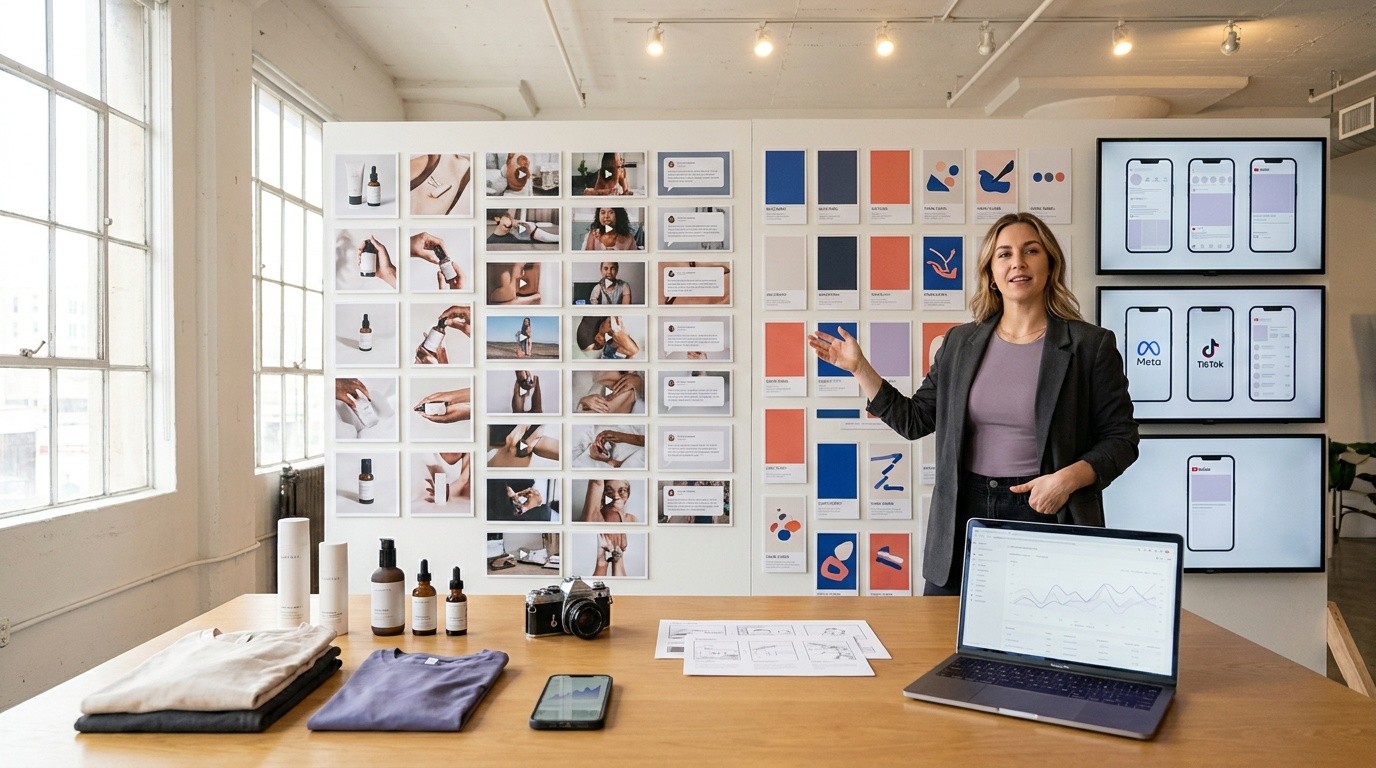
The solution is not simply producing more ads. It is building a modular ad creative system that turns one strong concept into a structured library of hooks, scenes, proof points, formats, and calls to action. This approach gives brands enough variation to learn quickly while preserving the strategic idea behind each ad.
That matters in a market where investment continues to move toward digital video and social platforms. According to the IAB and PwC Internet Advertising Revenue Report, US internet advertising revenue reached $259 billion in 2024, up 15% year over year. The IAB’s 2025 digital video report also found that digital video ad spend grew 18% in 2024 to $64 billion and was projected to reach $72 billion in 2025.
For DTC brands, the creative system is becoming as important as the media-buying system.
What is a modular ad creative system?
A modular ad creative system separates an advertisement into reusable components. Instead of treating each asset as one finished video or image, the team defines the parts that can change independently:
Hook: The opening claim, question, visual interruption, or customer problem.
Body: The demonstration, explanation, comparison, or product story.
Proof: Reviews, creator reactions, test results, before-and-after context, or founder credibility.
Product moment: The close-up, use case, texture, result, or unboxing sequence.
Offer: The reason to buy now, such as a bundle, subscription, free shipping, or limited promotion.
Call to action: The next step, from “Shop now” to “See how it works.”
These modules can be rearranged into multiple ads while keeping a consistent brand position. A supplements company, for example, might use the same “make the daily routine easier” concept across a founder explanation, a customer testimonial, a product demonstration, and a fast creator-style video.
The system begins with strategy, not editing. Define the audience tension, desired outcome, product promise, reason to believe, and tone before requesting dozens of variations. Octaze’s performance marketing and growth services reflect this combination of brand thinking and measurable execution: the strongest performance creative usually comes from a clear position translated into testable assets.
Build the concept before building the ads
A useful creative brief should answer five questions. Who is the ad for? What problem are they trying to solve? What have they tried already? Why is this product a credible answer? What action should they take next?
From those answers, create three to five core concepts rather than dozens of disconnected ideas. A concept is a repeatable strategic angle, not a single headline. Examples include “the routine that replaces three products,” “what I wish I knew before buying,” “the premium result without the premium hassle,” and “a founder explains the formulation.”
Each concept should then receive several hooks. For a skincare brand, the same concept might open with a close-up of the problem, a surprising customer confession, a product texture shot, or a direct question. The body can remain similar, while the first three seconds change substantially.
This distinction is important. Testing five unrelated ads may reveal a winner, but testing five hooks within a coherent concept reveals why the winner worked. It produces insight that can be applied to the next production cycle.
Produce a creative matrix, not a pile of files
A creative matrix maps concepts against formats, audiences, and messages. A simple version might include four concepts, four hooks per concept, two proof styles, and three aspect ratios. That creates a substantial testing pool from a manageable production day.
The goal is not to launch every possible combination immediately. The goal is to capture enough raw material that the team can make new versions without returning to production every week. Film product demonstrations in wide, medium, and close-up shots. Capture clean product-only footage, creator reactions, founder lines, customer language, and quiet moments suitable for overlays or voiceover.
During production, record multiple deliveries of the same line. Ask creators to perform it as a recommendation, a confession, a skeptical review, and a confident explanation. Capture natural pauses and imperfect takes too. On TikTok and Reels, polished advertising is not always the most persuasive style. The TikTok creative best practices guide recommends three to five different creatives per ad group, which makes planned variation more useful than one highly polished hero asset.
Organize every file by concept, hook, speaker, product moment, proof type, orientation, and date. A naming convention such as Concept03_Hook02_CreatorA_9x16_V1 can save hours once a library contains hundreds of assets.
Adapt the system to Meta, TikTok, and YouTube
A modular system does not mean uploading the exact same edit everywhere. The central idea can travel, but the opening rhythm, framing, length, and call to action should reflect each platform.
Meta: prioritize diversity and message relevance
Meta increasingly uses automation to determine which people receive which creative combinations. Its documentation on creative diversification describes diversification as creating different themes, messages, and visual treatments for different potential customers. Its Advantage+ Creative documentation also explains how the platform can generate or optimize variations of images and videos.
For Meta, build a balanced portfolio of creator-style videos, product demonstrations, statics, carousels, testimonials, and offer-led ads. Use different reasons to believe, not merely different background colors. One customer may respond to convenience, another to performance, and another to social proof.
Keep the first frame understandable without sound. Put the product or human subject in context quickly, and make the value proposition visible early. Test broad audience delivery when the account has sufficient conversion data, but continue supplying meaningful creative differences so the system has options to match different motivations.
TikTok: design for native attention
TikTok ads need to feel like content someone might reasonably watch in the feed. That does not require pretending the ad is not an ad. It requires a fast start, human presence, visual movement, and a clear reason to continue.
Use the first seconds to show the problem, result, unusual product detail, or emotional reaction. Avoid beginning with a logo animation or a long brand introduction. Write scripts in spoken language, use captions for silent viewing, and let creators demonstrate rather than describe whenever possible.
TikTok’s official creative guidance emphasizes its creative codes, including TikTok-first storytelling, sound, trends, and creator participation. Treat these as inputs for the concept, not decoration added at the end. A creator who genuinely fits the customer may outperform a more famous personality because the recommendation feels more credible.
YouTube: build a complete argument
YouTube gives brands more room to explain, demonstrate, and build memory. That makes it useful for prospecting, product education, consideration, and remarketing. Google’s ABCD framework for effective video ads organizes strong creative around Attention, Branding, Connection, and Direction.
In practice, attract attention with a relevant opening, introduce the brand early, connect the product to a real human need, and provide a clear next step. A longer YouTube version can contain the full product story, while six-second or fifteen-second cutdowns can isolate the strongest proof point.
Do not assume that a horizontal master video is enough. Produce vertical and square versions where appropriate, protect key visuals for different crops, and make sure the product and brand remain recognizable on a phone screen.
Test creative with disciplined iteration
The first version of an ad is a hypothesis. The testing process should identify which part of the hypothesis is working.
Start with a controlled test structure. Keep the offer and landing page stable while comparing hooks, or keep the hook stable while comparing proof styles. If every variable changes at once, the result may be useful for choosing a winner but weak for learning.
Evaluate performance according to the funnel stage. For prospecting, review thumb-stop or three-second view behavior, hold rate, click-through rate, landing page views, and blended customer acquisition cost. For lower-funnel ads, prioritize purchase conversion rate, cost per acquisition, contribution margin, and new customer revenue. A video with a lower click-through rate may still be valuable if it produces more profitable customers.
Use performance data alongside qualitative evidence. Read comments, customer service tickets, reviews, post-purchase surveys, and creator feedback. If customers repeatedly say “I did not understand what this was,” the problem may be the product explanation rather than the hook. If viewers praise a specific use case, turn that language into a new concept.
When an ad wins, do not simply increase spend behind it until it collapses. Extract the winning mechanism. Was it the visual demonstration, the customer wording, the objection it answered, or the pace? Then create new openings and proof combinations around that mechanism. This is how a single winner becomes a creative family.
Scale production without losing brand quality
Scaling requires a recurring operating rhythm. A practical monthly cycle might include one strategy session, one focused production block, weekly editing and testing, and a performance review that feeds the next brief. The creative team should share results with media buyers, and media buyers should share audience language with creative strategists.
Use templates for captions, end cards, product framing, color treatment, and legal review, but do not template away the idea. Consistency should make the brand recognizable, not make every ad look identical. Maintain a central creative library with status labels such as testing, learning, winner, fatigued, and archived.
Creative fatigue is not always a frequency problem. It can also happen when the audience sees the same promise, visual pattern, and delivery repeatedly. Rotate concepts as well as executions. Meta’s creative fatigue guidance can help teams identify when an audience has seen an asset too often, but the business response should include new messages and situations, not just a new crop.
For growing brands, this is where an experienced partner can create leverage. Octaze’s Discuss, Plan, Produce, Succeed approach is a useful model for connecting positioning, production, media execution, and measurable outcomes instead of treating them as separate services. The objective is a repeatable system that helps a brand learn faster with every campaign.
The operating principle that makes modular creative work
Modular advertising works when every variation has a reason to exist. More assets alone do not create better performance. A stronger system connects customer insight to a distinct concept, turns that concept into reusable production modules, adapts each module to platform behavior, and uses results to guide the next round.
For DTC teams on Meta, TikTok, and YouTube, the competitive advantage is not having one perfect ad. It is being able to produce, test, and improve credible ideas before fatigue turns yesterday’s winner into tomorrow’s liability. Build the system once, document what it teaches you, and let every new creative cycle make the next one sharper.
